Publishing for Practice Local Evidence and Patient Voices in Philippine Orthopaedics
Article Sidebar
Main Article Content
Abstract
Medical practice in the last few decades has increasingly moved toward evidence-based care. However, evidence is only as relevant as the context in which it is generated.¹ Much of current orthopedic literature originates from healthcare systems and patient populations different from those encountered in the Philippines.² For Filipino clinicians, locally produced research ensures that clinical decisions align with the realities of our patients, disease patterns, and healthcare environment.
I was fortunate to learn this important lesson directly from the late Dr. Antonio Montalban, the first Editor-in-Chief of the Philippine Journal of Orthopaedics and a pioneer of orthopedic research in the country. Dr. Montalban emphasized that advancing orthopedic care in the Philippines requires the systematic documentation and sharing of our own clinical experience. At a time when access to international publications was limited, he recognized the need for a platform where Filipino surgeons could publish local disease patterns, evaluate treatment outcomes, and contribute to knowledge directly relevant to Philippine practice.
While access to international journals has expanded considerably over time, the need for local publications remains. Differences in epidemiology, healthcare resources, and patient expectations mean that findings from other regions cannot always be directly applied to our setting. Local research therefore continues to ensure that clinical practice is guided by evidence that reflects the realities of Filipino patients.
Alongside this expansion in the use of local data, orthopedic research has also increasingly embraced patient-reported outcome measures (PROMs). Traditional clinical outcomes such as radiographic healing, range of motion, and complication rates remain important, but they do not always capture how patients themselves perceive recovery. These PROMs offer direct insight into function and quality of life from the patient’s perspective, helping clinicians understand the real impact of treatment on daily activities and well-being.³
For PROMs to be meaningful, however, outcome instruments must be culturally and linguistically appropriate for the populations in which they are used.⁴ Validating and applying these tools locally allows clinicians to measure recovery in ways that reflect patients’ social roles, tendencies, and expectations. As patient-centered care continues to grow in importance, the integration of PROMs into local orthopedic research allows us to evaluate outcomes that matter most to the people we serve.
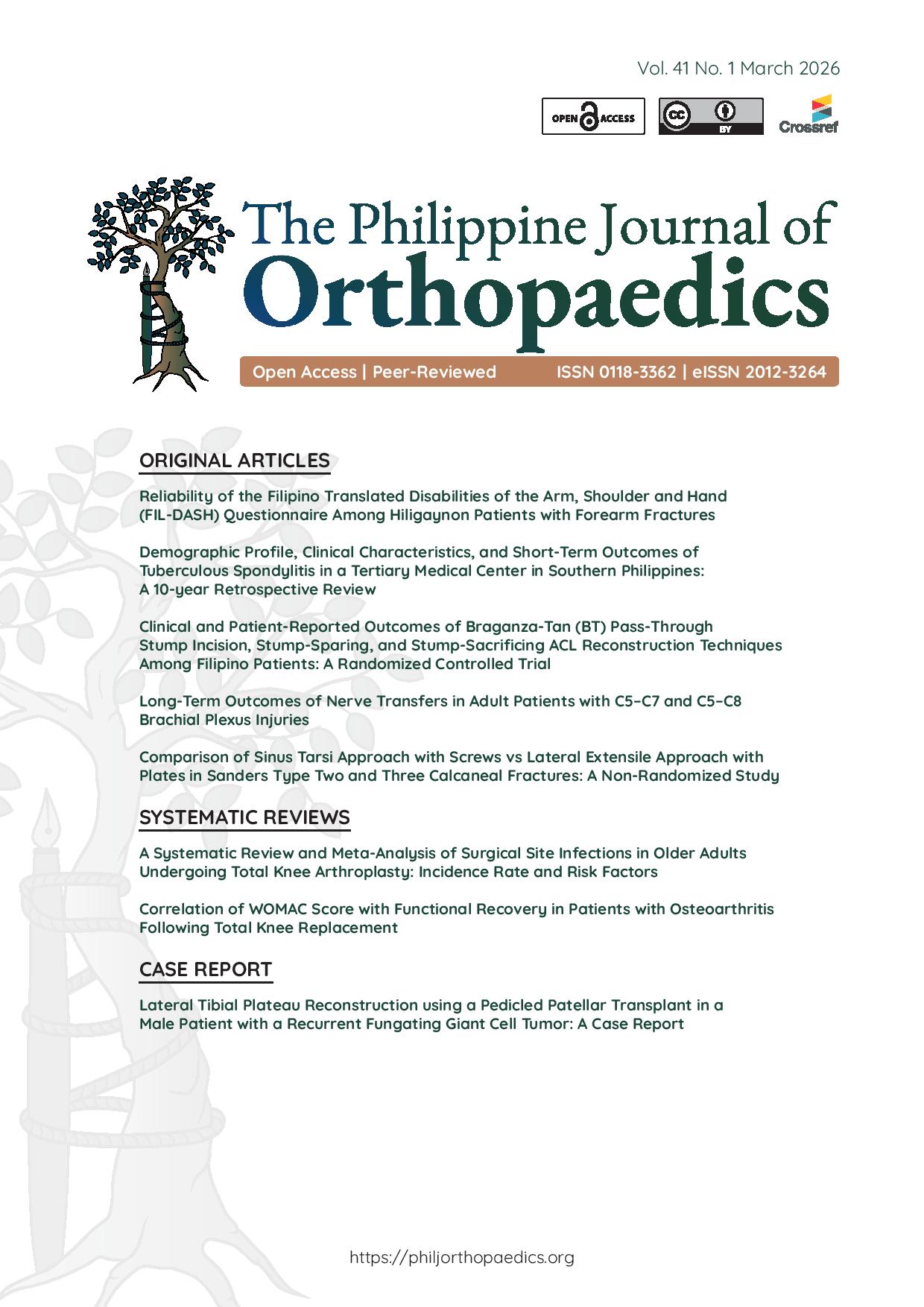
This latest issue showcases the range of contemporary orthopedic research, from epidemiologic observations and clinical outcomes to systematic reviews and complex reconstructive techniques. Together, these studies highlight the ongoing efforts of Filipino orthopedic surgeons and regional collaborators to generate evidence that informs both clinical decision-making and future research.
More importantly, these studies reflect a shared commitment to strengthening the evidence base that supports orthopedic care in our setting. As the volume of global literature expands, maintaining venues for locally generated scholarship becomes essential. Supporting and sustaining the Philippine Journal of Orthopaedics ensures that valuable clinical insights from our own institutions remain visible, accessible, and relevant to practitioners across the country.
Article Details

This work is licensed under a Creative Commons Attribution 4.0 International License.




References
1. Triposkiadis F, Brutsaert DL. Evidence-based medicine: past, present, future. J Clin Med. 2025;14(14):5094. https://pubmed.ncbi.nlm.nih.gov/40725787 https://www.ncbi.nlm.nih.gov/pmc/articles/PMC12295464 https://doi.org/10.3390/jcm14145094
2. Graham SM, Brennan C, Laubscher M, et al. Orthopaedic research in low-income countries: A bibliometric analysis of the current literature. SICOT J. 2019;5:41.https://pubmed.ncbi.nlm.nih.gov/31769752 https://www.ncbi.nlm.nih.gov/pmc/articles/PMC6878915 https://doi.org/10.1051/sicotj/2019038
3. Jin H, He M, Xie W, Xiong Z, Deng Z, Li Y. Research trends of patient-reported outcome measures in orthopedic medical practices: a bibliometric and visualized study. Medicina (Kaunas). 2023;59(9):1664. https://pubmed.ncbi.nlm.nih.gov/37763783 PMCID: PMC10536719 https://doi.org/10.3390/medicina59091664
4. Van Lieshout EMM, Wijffels MME. Patient-reported outcomes: which ones are most relevant? Injury. 2020;51 Suppl 2:S37-42. https://pubmed.ncbi.nlm.nih.gov/31708093 https://doi.org/10.1016/j.injury.2019.10.073